
Lately, I've been having conversations with AI founders in Singapore that keep surfacing the same pattern: more and more B2B AI companies are no longer positioning themselves as "tech companies that serve an industry." Instead, they're becoming players in that industry — but with AI as their operating system, they can do it faster, cheaper, and at a scale that incumbents can't match.
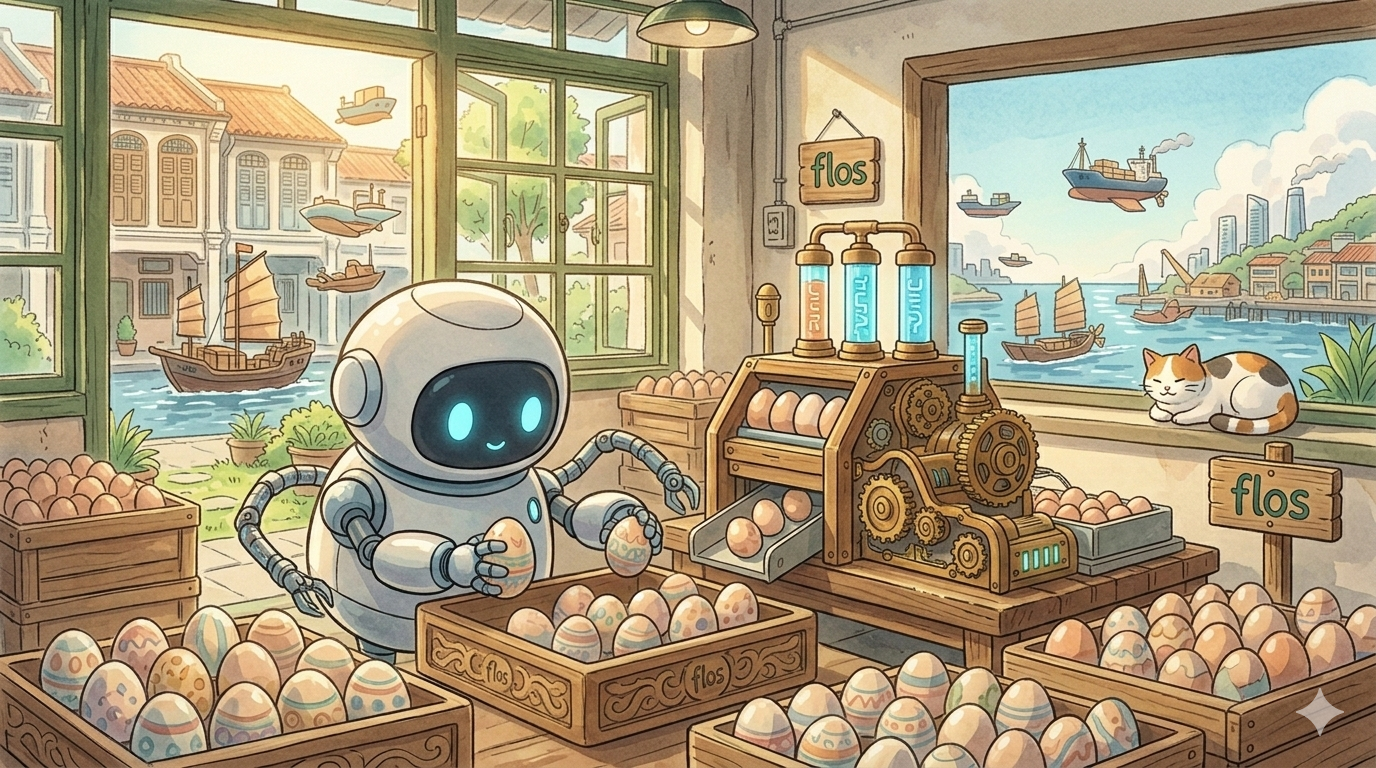
The most vivid example I've come across recently is a company that calls itself "an egg trader in Singapore."
Yes. They sell eggs.
But they're actually an AI-powered food supply chain company. Their system optimizes procurement, routing, and inventory. Restaurant owners place orders through WhatsApp — no apps to download, no portals to learn — and the entire fulfillment chain runs behind the scenes. The result: eggs that are cheaper and fresher than what traditional distributors offer.
The Numbers Tell the Story
With just five people, this company signed up nearly 2,000 local restaurants in its first year. They spent another year obtaining one of Singapore's coveted egg import licenses — a permit held by only 15 companies in the entire country. Within a year of launching, they became Singapore's sixth-largest egg trader by volume.
Now they're moving into their second product line: cooking oil. Annual revenue is already in the millions of dollars, and supply chain–focused strategic investors are knocking on the door.
The AI-Native Playbook
What makes this founder remarkable isn't the technology. It's the framing. He doesn't talk about AI. He doesn't talk about disruption. He just says he's "a guy who sells eggs."
But here's what he's actually built:
- A business that gets stronger as large language models improve — because better models mean better demand prediction, better routing, better margin optimization.
- A company whose competitive moat deepens with each AI upgrade — because the proprietary data they've accumulated on Singapore's restaurant supply patterns can't be replicated by a newcomer with a better model.
The moat isn't the model. It's the data you accumulate while the model is still your advantage.
Why This Pattern Matters
This isn't an isolated case. I'm seeing the same playbook across multiple verticals in Singapore's AI ecosystem:
The AI company doesn't position as a vendor. It becomes a competitor — but one with fundamentally different unit economics. A traditional egg distributor needs warehouse managers, route planners, procurement teams, account managers. This company replaced most of those functions with AI and runs the whole operation with five people.
That's not "providing AI services to the food industry." That's a category-level disruption, delivered quietly through WhatsApp messages about egg prices.
The Bigger Insight for AI Founders
The lesson here goes well beyond food distribution. In this era, the most interesting AI companies aren't the ones building horizontal tools. They're the ones picking a specific, high-frequency, margin-rich vertical and going all in — not as a software provider, but as a participant.
The pattern: Find an industry where the incumbents are slow, the margins are real, and the workflow can be compressed by AI. Then don't sell to that industry — become a player in it. With AI as your backbone, you start with a structural cost advantage that compounds over time.
Singapore is an especially fertile ground for this kind of venture. The market is small enough to dominate quickly, regulated enough that licenses create real barriers to entry, and connected enough to serve as a proof of concept for expansion into the broader Southeast Asian market.
When I think about what Flos does — helping AI companies find their footing in international markets — stories like this are exactly why I find the work so compelling. The founders building the most defensible businesses aren't the loudest about AI. They're the ones quietly cornering a market while everyone else is still debating which model to use.
This is an installment of Field Notes, where I share first-hand observations from Singapore's AI ecosystem. If you're building in AI and thinking about going global, I'd love to hear from you. Subscribe to Field Notes for more.